 There are many Americans of all ages living in Islington, and whenever I am in Montes, I have usually met a compatriot. Nowadays, the socially
 distanced very long lines have engendered a feeling of camaraderie amongst those of us who have not been acquainted before and, indeed, amongst those of all nationalities living in this cosmopolitan part of the capital. We no longer just ‘look through’ people whom we have come across frequently over the years, we now strike up conversations and snippets of quite personal history may be revealed.
In the chats about ‘this and that’ I learn or can confirm that my family and I are not the only ones drawn to Montes for its looks, produce and because the owners, especially Hamid Quereshi, the original proprietor, brim with charm. I tell my ‘new friends’ that the shop beckons to me because Hamid’s life story touches me. With each purchase, I read another page or two, if not another paragraph.
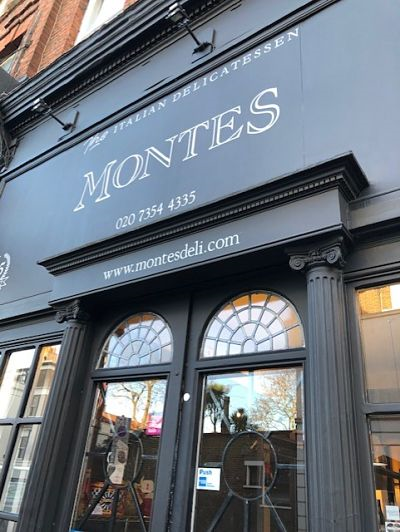
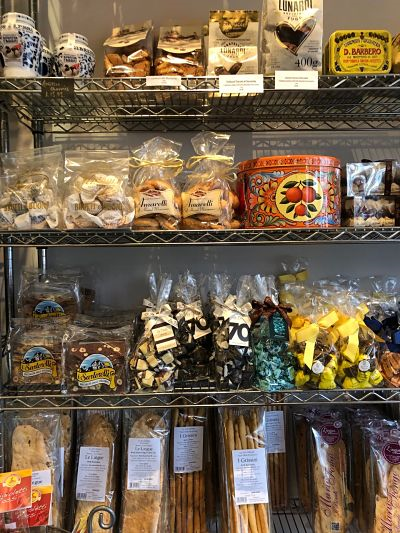
The shop appears as if it could be a living museum of edible objects, artfully wrapped up or displayed. One might think that the displays have been curated by someone with a passion for gourmet cuisine. The packaging is so pleasing that one almost does not wish to undo it and enjoy the contents. Hamid’s partner in business and life is Alicja; her face and aura of tranquillity make me think of a short, dark haired version of the Mona Lisa. (There is no staff. “Staff can mean more work; you are always doing their work, covering them,” Hamid believes.)
Hamid has told me that he has personally chosen and sampled, if not eaten regularly, every item for sale. “Over the 27 years I have had the shop, I‘ve built up friendly relationships with my suppliers, be they Italian, French or Spanish. They appreciate our reputation; they trust me and I trust them. Some of the products we sell are exclusive to us. You’re unlikely to find them elsewhere in Britain, certainly not in supermarkets or large scale food establishments. There may be perhaps only one other shop in Britain selling the renowned Spinosi pasta. Our products are also bought by Michelin starred restaurants in the UK and certain celebrity chefs.”
Looking always makes me feel hungry. There is a fine feast for choice. Interestingly, and oddly, the prices are lower on the whole in comparison with many of other speciality goods I have seen in London shops. Hamid says that he would rather “operate with a slightly lower profit margin than I could, in order to shift the stock and ensure that it is always fresh and none goes to waste. The chilled savoury fare is the shop’s most popular produce. Next come the oils”.
In the chilled counter, there are antipasti such as olives, anchovies, red peppers, mushrooms, artichokes, and black olive and aubergine pates. We like the banderillas, a Spanish delicacy in origin. They are green olives stuffed with red peppers with an anchovy wrapped around them, skewered on a toothpick. Fresh pasta is filled with wild boar, and spinach and ricotta. The lasagne, for reheating at home, is made by Hamid and Alicja. The cheeses are mostly French and Italian. There is a selection of cured meats and sausages.
On the white wooden and wire rack shelves, one finds bottled coq au vin, boeuf bourguignon, duck confit and cassoulet, pates, soups – chicken, fish, tomato, gazpacho – an overwhelming array of artfully shaped pasta, sweet and savoury biscuits , olive oils and vinegar, confectionary, spirits, still and sparkling wines. You can buy juices, water and coffee, too, and gelati from the freezer.
Monte’s does not usually sell fresh fruit and vegetables. This is in keeping with the definition of the word delicatessen, a small shop selling high quality foods, such as types of cheese and cold cooked meats, often from other countries. Delicatessen is a German word which first appeared in English in the mid 19th century. The German form was inspired by the French word delicatesse which was borrowed from the Italian delicatezza. This comes from delicato, a Latin word which stems from delicatus, meaning delicate or, as some authorities note, giving pleasure, delightful.
Hamid serves generations of families. Some of the dedicated he has known since they were just born. The shop is never empty. Some customers who have relocated ask Hamid to send some of his delicacies to them. Hamid and Alicja will make up hampers for presents; you choose the stock. They will also make up sandwiches with ciabatta – the best ciabatta I have ever tasted. Choose whatever fillings your stomach desires; perhaps taleggio with salami and a knife spread of fresh pate topped with red peppers will satisfy?
Why is the shop called Monte’s? Is this name meant to imply that a mountain of delicacies await inside, monte being Italian for mount and mountain? “Monte is the family name of a former business associate. We used to have a delicatessen together on nearby Pentonville Street, before I started this shop. I have never thought that my names would be a ‘good idea’ for this sort of shop being that they are Kashmiri,” reveals Hamid. It is sad that this reality existed at the time of naming.
 Why did Hamid go into the food retail business? Hamid explains that he grew up in Nottingham. His father settled in Britain during the 50s, coming from Pakistan; and he first worked as a bus driver. His mother is English. (Hamid is in his early 60s, though he looks far younger, and I am not trying to flatter him.) Eventually his father established a meat wholesale business. During his teens, Hamid would help him with various tasks. Then his father opened a grocery store, selling goods over the counter. (These were the days of paper, not plastic, bags!) His father progressed to turning his hand to opening one of the first self-service grocery shops in the area for Asian and West Indian buyers. One would buy pre-packaged food by choosing it from the shelves, rather than asking a salesperson to weigh out goods or give them ‘so many’. Hamid remembers helping his father package the loose goods, such as rice and biscuits, for the shelves. He recalls the popularity of the yams and plantains.
“When I was ready to embark on a career, I wanted to express my love of European cuisine, especially my great taste for Italy, in a shop, a shop with personality,” Hamid says. The wholesale business would be too impersonal. It was almost serendipity that he settled in Islington. (Hamid and Alicja live in Walthamstow.) Hamid says now he “would like to be travelling the world, but I’m stuck”. He is on his feet all day at the shop. On Christmas Eve, he and Alicja did not have breakfast until late afternoon. (Judging from the length of the lines, this is probably the case now.)
Hamid and Alicja met when Alicja came to work at the shop fourteen years ago. “I have no one to leave the business to; she has a 50% share. She is a good mother to my son, Sam; she is very understanding. Sam is severely autistic and has epilepsy. He is nearly 23. He lives at a wonderful residential care home, Prior’s Court, which was established by Dame Stephanie Shirley, a remarkable woman.”
Hamid’s praise is quite justified. Dame Shirley was an unaccompanied refugee, who became a successful IT entrepreneur and philanthropist. Her son, Giles, was autistic. He died in 1998, aged 35. Dame Shirley established The Shirley Foundation, now the Autistica charity, which fosters through research greater understanding about autism. Prior’s Court is near Newbury, Berkshire. The school is based in a grade II* listed Queen Anne House which has purpose built classrooms and accommodation. The curriculum includes art, music, sport, communication and social skills, domestic science, horticulture and animal husbandry. It helps to nurture skills for employment. The school is filled with examples of British art, craft and design, some of the work has been specially commissioned. There are 55 acres of grounds and woodlands. The sixty pupils range in age from five to nineteen. There is also Young Adult Provision for young people between the ages of 19 and 25. Placements, based on strict criteria, are funded by local authorities. ( See Prior Court) Hamid and Alicja make up hampers to be auctioned for the school’s fundraising occasions.
Hamid has shown me pictures taken recently when he was on holiday with his son in Bodrum, Turkey. I see Sam paragliding and jet skiing. Hamid chuckles when he remembers taking Sam to a Turkish bath. Sam looks like his father, with black almond shaped eyes, thin lips, high cheekbones, olive skin, and lean in body. “I try to give Sam a normal life. When he comes home, it is hard work looking after him. I do not just brush my teeth, I brush his. I bring him to work sometimes. He likes lasagne, so when he sees people buying it, he wants to take it off them! He doesn’t understand. When I take him to my father’s grave, I believe he feels a spiritual sense. He smiles a lot when he is there. Who knows!”
I am always struck by how clean the shop looks. It is bright, airy and not cramped. At a glance, the small kitchen looks spick and span, too. The walls are white except for the one behind the counter, which is a fashionable steely grey and embellished with a plaster coving, a chunky dentil course below an ogee curve; this is broken up with several fluted pilaster and ‘floral’ capital additions. The decoration makes one think of Greek and Roman temples. “People ask me ‘who is the architect?’ and I say ‘me’”, Hamid chuckles.
When you visit the shop, please tell Hamid that Jenny sent you. Treat yourself to a ciabatta sandwich with pecorino and roasted vegetables instead of a ‘lockdown takeout’. Montes is closed on Mondays. Visit the Website